
Hamilton County Past Resident Sources
The backward trail changes with the era. Current county systems establish the parcel and newest owner. Recorder indexes extend the legal chain. Hamilton East Public Library and the Indiana State Library bridge older address and name evidence. Maps prove place and building context, while directories, census schedules, newspapers, and funeral or cemetery sources carry the household evidence.
| Source | Years covered | Where held | What it can show |
|---|---|---|---|
| Recorder deed materials | Online deeds 1947 to present; historical indexes 1870 to 1963 | Recorder, Fidlar, public terminals | Grantors, grantees, legal description, transfer record |
| Hamilton County directories | As early as 1874 through 2000, with gaps | HEPL Indiana Room and digital partners | Dated resident, address, business, or postal association |
| Haines Criss-Cross | 1976 or late 1970s to most current year | HEPL Indiana Room | Address-first occupant or subscriber clue |
| Sanborn maps | Noblesville 1887, 1905, 1914; Sheridan 1896, 1902, 1909, 1925 | Library of Congress and reference routes | Street, lot, footprint, use, and building continuity |
| Historic plats and aerials | Plats 1933 to 1999; aerials 1936 to 1994 in listed years | Hamilton County maps collection | Lot shape, subdivision, roads, and physical change |
| Census and probate leads | Series-dependent | Federal census tools, Clerk, State Library, IARA | Household, heirs, estate, and address context |
Start with the most recent source that can identify the correct parcel. Then use the legal description, not merely a copied street string, to cross a rename, split lot, or new house number.
Start Hamilton County Address History
Search Hamilton County Property Reports by property address. Save the county and state parcel numbers, current ownership, transfer history, property-card year, and assessment update date. In the parcel layer, add the legal description, subdivision, block, lot, last transfer date, owner mailing address, LRSN, and property-report link.
The owner mailing address may point elsewhere. It records where correspondence goes, not who occupied the house. The assessor’s current owner also may not appear at once after a recent transfer because the system follows its own update cycle. Label this first row “current owner of record,” then build separate columns for owner, mailing recipient, and dated occupant.
The county’s partial-address search accepts a house number and street characters. A 16-digit duplicate number or 18-digit state parcel number is more stable once found. Those identifiers also keep two similar street names from being merged.
Trace Hamilton County Deeds Backward
The latest deed is the first handoff in a chain of title, the linked series of recorded ownership transfers. Use the Hamilton County Recorder’s search page for Fidlar Laredo or Tapestry, and keep the instrument data beside the parcel record.
- Find the current owner’s purchase instrument. Record document type, recording date, document number, parties, and book or page when shown.
- Confirm that the deed’s legal description matches the parcel. A similar surname or street is not enough.
- Treat the seller as the next prior owner candidate. Search that grantor as an earlier grantee, testing visible spelling or initial variants.
- Repeat the handoff and note image access. Separate execution date from recording date when both appear.
- At the online cutoff, move to public computers, published historical indexes and books, a known-document copy request, library collections, or archives.
- Grantor
- The party conveying an interest in the recorded instrument.
- Grantee
- The party receiving that interest. On a sale deed, today’s grantee may become a later grantor.
- Chain of title
- The sequence of transfers tied to the same land.
- Legal description
- The recorded parcel language, often based on subdivision, lot, section, township, or range, that outlasts many street changes.
The Recorder publishes deeds online from 1947 and miscellaneous documents from 1973. Historical deed indexes cover 1870 through 1963, and selected book ranges reach May 1899 through January 1949. These ranges overlap and do not promise a free scan for every entry. Recorder staff provide known copies but do not perform open-ended searches or legal analysis.
Hamilton County Abstracts Bridge Gaps
The Stewart Title Abstract Collection at Hamilton East Public Library’s Indiana Room is a strong mid-century bridge. Its Hamilton County property-transfer papers can preserve legal descriptions and historic title clues between a modern parcel report and older Recorder books. The index is available on request, so provide the address, parcel or legal description, known owner, and likely period rather than asking staff to search every county name.
Genealogy consultations are available in person without an appointment. Crossroads Discovery Center staff can also route researchers among directories, reverse volumes, newspapers, funeral records, maps, surname files, and digitized books. The contact number is 317-770-3236, and mail goes to Hamilton East Public Library, One Library Plaza, Noblesville.
Review the Indiana Room house-history resources before contacting staff.
The library route fills gaps that cannot be solved through a current parcel portal alone, especially for prior residents and mid-century transfers.
Hamilton County Previous Resident Households
Ownership is only one layer. Haines Criss-Cross volumes begin in 1976 or the late 1970s and continue to the most current year held, with gaps. They are searched by address. A line may identify an occupant, subscriber, or business associated with that address in that publication year. It does not establish title or continuous residence.
For earlier periods, pair the closest directory year with a federal census year. First locate the street-number entry or name line. Next search the census for the same person, family members, approximate ages, and nearby households. Then compare the deed or parcel evidence. Repeat in the next available directory year rather than assuming the household remained unchanged.
- Write the exact directory title, publisher, year, page, section, and spelling.
- Match the address or historical street variant, then identify the relevant census enumeration area if needed.
- Compare household names and ages without merging people who share initials.
- Check a deed, obituary, probate file, cemetery source, or later directory for a second dated link.
The library’s 1916 Hoffman directory has residence entries beginning at page 103, a street-number section at page 215, and a county list at page 238. The 1907 to 1908 county gazetteer and the 1874 People’s Guide add older context. Full holdings and reading methods belong on the Hamilton County city directory page.
Map Hamilton County Previous Residents
Maps do not name every person, but they test whether the place existed when a directory or deed says it did. Noblesville Sanborn editions are available for 1887, 1905, and 1914. Sheridan editions cover 1896, 1902, 1909, and 1925, though the 1925 record is not available online. Inspect the sheet key and symbols. A label may identify use, a business, or an owner rather than an occupant.
Hamilton County also lists aerial photographs for 1936, 1941, 1956, 1962, 1972, 1974, 1985, and 1994. Historic plat books cover many dates from 1933 through 1999. Compare parcel shape, road alignment, subdivision, and building footprint with the deed legal description.
Use the county’s maps, aerials, and plats collection as the place-evidence layer.
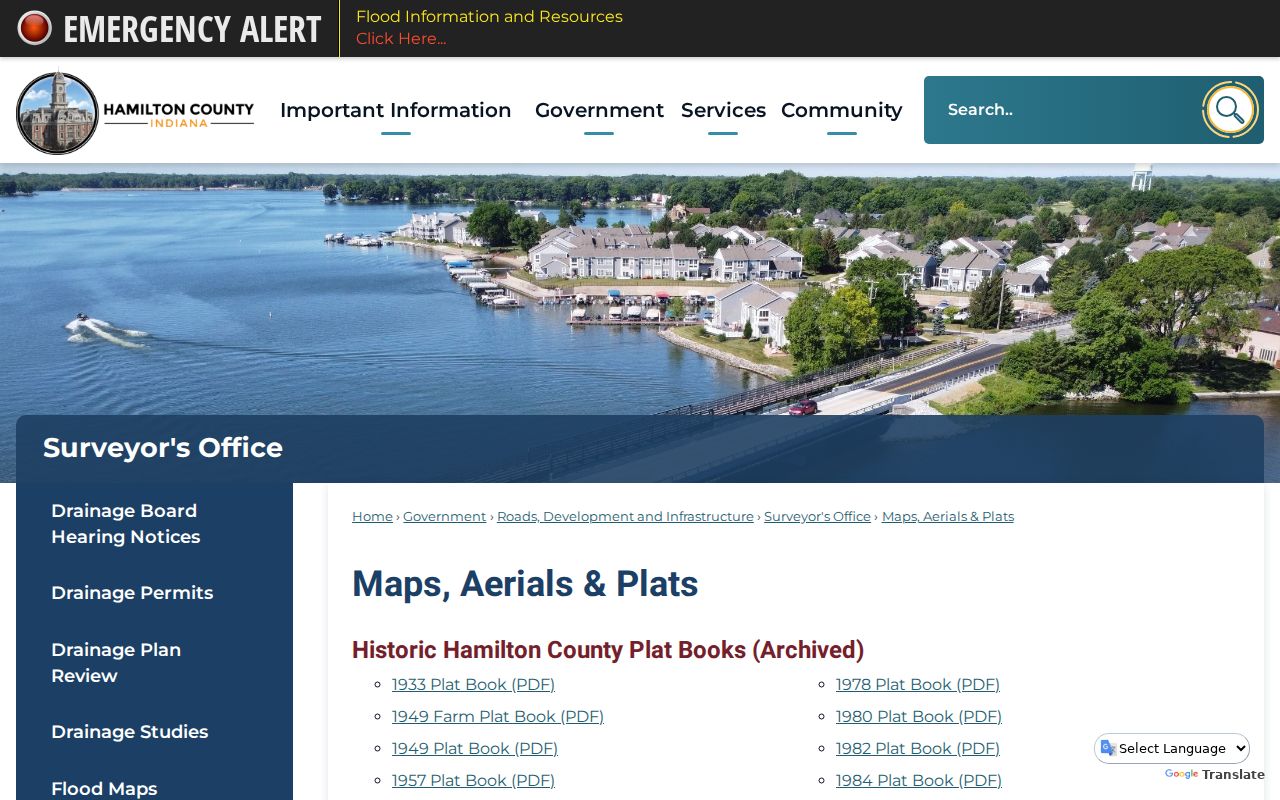
The listed runs let a house history test physical change between deeds and directory years without claiming that a map symbol is a resident name.
Renamed Hamilton County Addresses
The county-hosted article about the 1866 Noblesville map preserves crucial street bridges. Wiltshire became Maple Avenue; Emmaus relates to Cherry Street; Jack became North 16th; Polk became South 8th; Catharine became South 9th; Anderson became 10th; and Emmons became 11th. Search both old and later forms. Also test Hanibal and Hannibal spellings.
No complete countywide renumbering index was verified. Treat the article as a lead and confirm the match through the scanned map, plat, directory street section, and legal description. A name bridge can explain why previous residents disappear from an exact modern-address query, but it cannot prove that every number remained constant.
Note: A legal description and plat are stronger cross-era keys than an address copied from a single directory or newspaper item.
Close Hamilton County Resident Trails
When a person vanishes from the directory sequence, use dated local sources to find the next event. HEPL’s Evans-Godby-Trout funeral-home compilation covers 1891 through 1962, with described books spanning 1924 through 1950. Newspaper indexes, cemetery resources, probate abstracts, wills, and marriage records can supply death, family, estate, or relocation context.
The Indiana State Library county guide identifies will abstracts from 1824 through 1901, complete probate abstracts from 1829 through 1855, marriage abstracts and WPA indexes, naturalization materials, and original-record custodians. An index is a pointer. Seek the Clerk, Recorder, health custodian, or archive copy when the research question requires proof. The Indiana State Archives was moving in 2026, so check remote help and current appointment status before travel.
A careful prior-resident timeline records the source date, label, and uncertainty. “Directory occupant in 1916” is accurate. “Lived here continuously” is not supported without more evidence.
Use Hamilton County Past Records Lawfully
House history, genealogy, heir research, and personal curiosity are sound reasons to trace previous residents. Publish no unnecessary details about a living person. Address Confidentiality Program substitute addresses are not physical-location evidence. Restricted vital records, sealed cases, protected voter fields, and victim information remain protected.
If a Recorder instrument appears suspicious, use the county’s current Property Fraud Alert, introduced after the May 2025 system change, and contact the Recorder about the instrument. The alert sends notice when a document is recorded in a submitted name; it does not prevent fraud or settle title.
Lawful use. Keep Hamilton County previous-resident research focused on the property and its history. Never use it to track, harass, threaten, or expose a living person.